What do people in Malaysia eat in a day?
Malaysians eat rice or noodles at most meals, cooked three ways: Malay, Chinese and Indian. Breakfast is often nasi lemak or roti canai, lunch is mixed rice, and mamak stalls keep serving teh tarik late into the night.
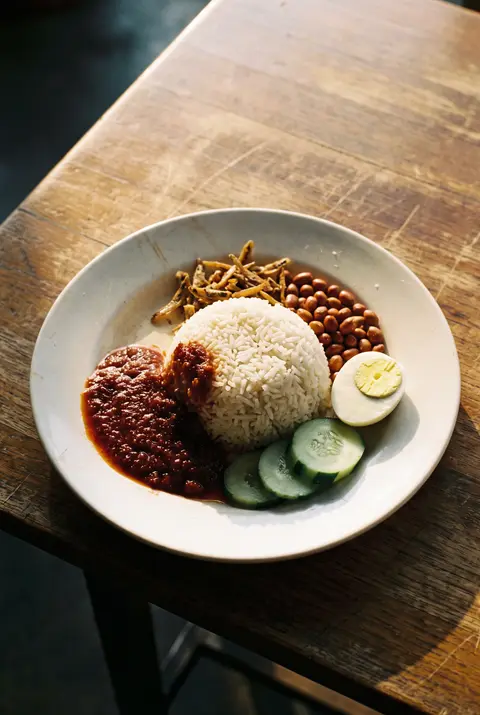
Typical dishes and their calories
Breakfast
Nasi lemak is the classic: rice cooked in coconut milk with ginger and lemongrass, served with sambal, fried anchovies, peanuts and egg, about 490 kcal for a plain packet. At the kopitiam, the old coffee shop, it is kaya toast, toast with coconut jam and butter, with boiled eggs. At a mamak it is roti canai, flaky flatbread with dhal or curry, about 330 kcal for two.
Lunch
Lunch is nasi campur, mixed rice: you take a plate of rice and point at what you want from a long row of curries, fried fish, vegetables and eggs. Nasi kandar is the Indian Muslim version, rice drowned in several curries. Banana leaf rice comes on a leaf with vegetables, meat and curry around a pile of plain rice.
Dinner
Dinner is rice with several dishes shared at once, not one course after another. Many families eat out at hawker stalls and food courts, where a bowl of curry laksa, noodles in a coconut curry broth with chicken or prawns, is about 590 kcal. Malays are Muslim and do not eat pork, so a mixed table keeps to chicken, beef and seafood.
Starters
Malaysian meals have no starter course. Everything arrives together. Satay is the closest thing, grilled skewers of chicken or beef with peanut sauce, cucumber and onion, ordered by the stick. Five are about 400 kcal. Kuih, small cakes made with coconut milk and palm sugar, are eaten as a snack at any time.
Desserts
Cendol is green rice flour jelly with coconut milk and palm sugar syrup over shaved ice, often with red beans. Pisang goreng, fried banana, is about 200 kcal a piece. Kuih covers all the small cakes and sweets, most of them made with coconut milk and palm sugar. Durian, the spiky king of fruits, is eaten on its own.
Drinks
Teh tarik is black tea with condensed milk, poured back and forth between two mugs until it froths, about 230 kcal a glass. Kopi, the local coffee, is about 140 kcal with condensed milk. Milo, the malted chocolate drink, is on the menu at every kopitiam and mamak, and the big iced Milo dinosaur is about 360 kcal.
Street food
Hawker stalls, mamak stalls and pasar malam, the night markets, are where most people eat out. Char kway teow, flat rice noodles fried over high heat with Chinese sausage, cockles and egg, is about 740 kcal a plate. Asam laksa is the sour one, noodles in a spicy and tangy fish broth, and Hainanese chicken rice is cooked in chicken stock.
Normal there, odd elsewhere
Many mamak stalls are open 24 hours, and a table of friends will sit over roti and teh tarik long after midnight in front of a big screen. Durian smells so strong that some hotels and public transport in Singapore and Bangkok ban it. A good char kway teow is judged by its smoky taste from the very hot wok.