Who invented carbonara?
Nobody knows for sure. Carbonara appears in print only around 1950, and the best known theory ties it to Rome in 1944, when Allied rations of eggs and bacon met Italian pasta.
Pasta carbonaraRestaurant plate800kcal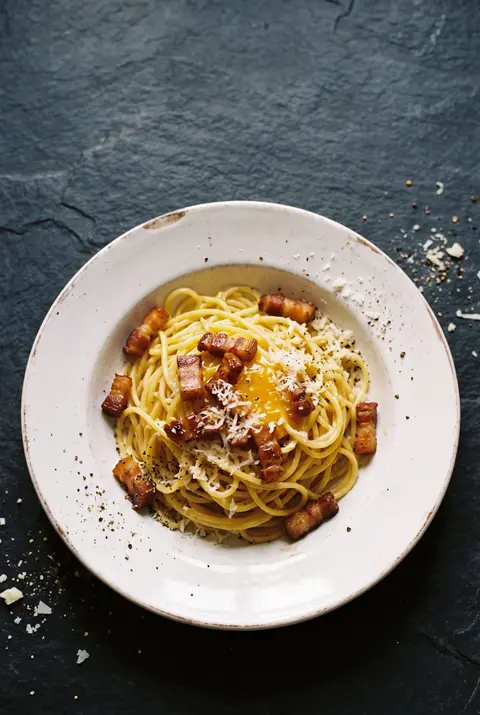
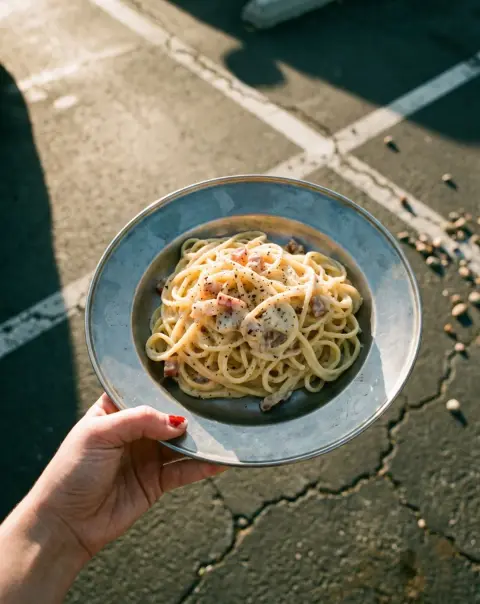
Younger than you think
Carbonara tastes like something Roman grandmothers have made for centuries. The paper trail says otherwise. Italian food writing barely mentions it before the 1950s. A Dutch newspaper in 1939 named a restaurant in Trastevere, the old Roman quarter across the Tiber, that served a dish with the name, but it never said what was in it. So for a pasta that feels this traditional, the record is short. It starts around the middle of the last century and not much earlier.
Rome, 1944
In 1944 the Allies took Rome, and the city was hungry. Real food was scarce, and some of what there was came from army supplies: eggs, often powdered, and bacon. In 1950 the Italian paper La Stampa wrote that American officers had been looking for spaghetti alla carbonara in Trastevere for years. It said the eggs and bacon came with the troops and the pasta was Italian, and the genius too. That line is still the most quoted thing ever written about the dish.
The legend and the soldier cook
The best known name is Renato Gualandi, a cook from Bologna. His own account says that in 1944 he cooked for American and British troops and mixed their bacon, cream, cheese and egg powder into pasta. It is a good story, and it is his story. HistoryNet says plainly that none of it can be confirmed. Other theories link the name to charcoal burners, carbonari in Italian, or to the secret society of the same name. Neither has solid evidence behind it.
From Chicago to the Italian kitchen
The first printed recipe did not come from Rome. It came from Chicago, in Patricia Bronté's 1952 book Vittles and Vice. Italy's magazine La Cucina Italiana printed its first version in 1954, and it used pancetta, garlic and Gruyère. Guanciale, the cured pork cheek, and pecorino romano became the standard only in the late 1950s and 1960s. Cream and garlic stayed in many recipes for decades and slowly dropped out by the 1990s.
What it is today
Today the version most Romans will defend is short: pasta, guanciale, egg yolks or whole eggs, pecorino and black pepper. The egg cooks gently in the heat of the pasta and turns into a glossy sauce, with no cream. An older dish called cacio e uova, eggs and cheese with no meat, was written down as early as 1839 and may be an ancestor. A usual plate is a bowl of spaghetti or rigatoni, and it is filling, because egg, cheese and pork fat are the whole sauce.