Who invented crisps?
Legend credits chef George Crum in Saratoga Springs, New York, in 1853, but historians doubt it. An English cookbook printed a recipe for potatoes fried in thin slices back in 1817.
CrispsA small bag (25 g)134kcal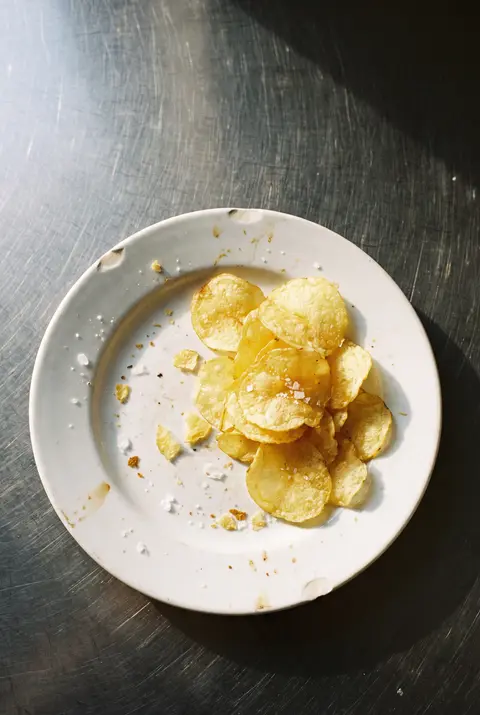
The famous story
The story goes like this. In 1853, at Moon's Lake House, a resort restaurant in Saratoga Springs, New York, a guest kept sending his fried potatoes back because they were too thick. The cook, George Crum, got annoyed. He sliced the potatoes as thin as he could and fried them until they were too crisp to eat with a fork. The guest loved them. Other diners asked for them too, and they became known as Saratoga chips. In many versions the fussy guest is the rich railroad man Cornelius Vanderbilt.
The problem with the story
It is a great tale and very likely not true. The historian T.J. Stiles, who wrote a Pulitzer Prize winning biography of Vanderbilt, said there is no truth to the Vanderbilt part. Crum's own obituaries in 1914 mostly did not mention chips at all. In 1849, four years before the famous night, the New York Herald already praised a Saratoga cook called Eliza for her crisp fried potatoes. Crum's sister, Catherine Wicks, and later the hotelier Hiram Thomas were both called the inventor in their own obituaries.
An English recipe from 1817
The oldest known recipe is older than all of these claims, and it is not American. In 1817 an English doctor, William Kitchiner, published a cookbook called The Cook's Oracle. It included potatoes fried in slices or shavings. So the thin fried potato was probably not invented in Saratoga, and possibly not in the United States. What historians do agree on is that Saratoga made them famous, and that Crum, who opened his own restaurant near the lake in 1860, helped a lot.
From barrels to bags
Early shop crisps were kept in barrels or glass jars and scooped out by weight, so they went stale fast. In the 1920s mechanical peelers and continuous fryers made big batches possible. In 1926 Laura Scudder in California came up with a bag made of two sheets of waxed paper pressed together, which kept them fresh. In the late 1930s Herman Lay's company became the first to sell a crisp brand across the whole United States. Mass production turned a resort snack into an everyday one.
Crisps today
Americans still say chips, while in Britain and Ireland they are crisps, and chips are what you eat with fish. The idea has barely changed since Kitchiner: thin slices of potato, fried or baked, and salted. The flavours have grown, from barbecue to sour cream and onion, cheese, vinegar and chilli. Some, like Pringles, are not slices at all but potato flakes pressed into a dough. A typical small bag is around 25 to 30 grams.