Who invented champagne?
No single person invented it. An English doctor, Christopher Merret, described adding sugar to wine to make it sparkle in 1662, and the Champagne region in France turned bubbles into its craft between about 1670 and 1720.
ChampagneGlass (125 ml flute)95kcal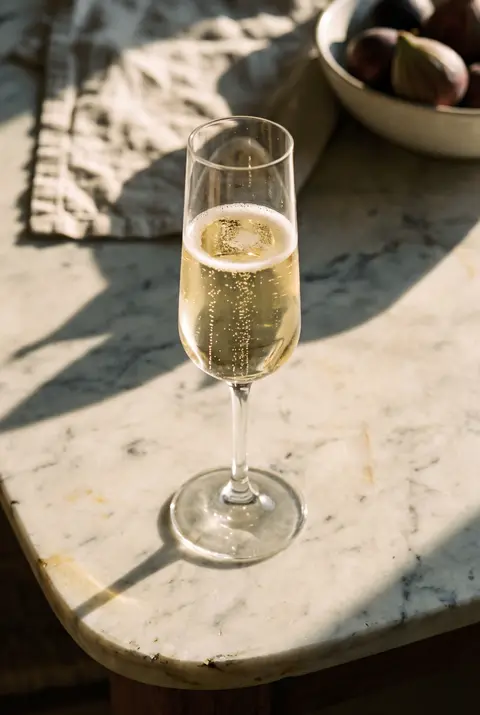
A region before a drink
Champagne is named after a region in northeast France, and that region made wine long before it made bubbles. Vines grew there by the 1st century AD, under the Romans. In 496 the Frankish king Clovis was baptised in Reims, and the city became the place where French kings were crowned. The local wine came to be called the wine of kings. For centuries, though, it was still wine, with no fizz made on purpose.
The monk who did not invent it
The famous story says a Benedictine monk, Dom Pierre Perignon, invented champagne at the abbey of Hautvillers and cried that he was drinking the stars. Historians say no. Perignon became cellar master there in 1668 and was a gifted winemaker. He was known for blending grapes from different plots and for pressing black grapes gently to make white wine. The legend was spread in the 1820s by Dom Grossard, who worked at the same abbey. Perignon died in 1715.
An English doctor writes it down
On 17 December 1662, six years before Perignon took over the cellar, a doctor named Christopher Merret read a paper to the Royal Society in London. He described how English wine coopers added sugar and molasses to wines to make them drink brisk and sparkling. That is a second fermentation in a closed vessel, the basic trick behind champagne. Merret was a founding fellow of the Royal Society and librarian at the Royal College of Physicians. Nobody remembers him on a label.
Corks, glass and a widow
In Champagne itself, sparkling wine became a deliberate choice between about 1670 and 1720. Cork stoppers reached the region in 1685, and the words Champagne wines show up in writing around 1690. After Louis XIV died in 1715, the Duke of Orleans served it at his lavish parties and the French court took to it. Ruinart opened in 1729. Later, Barbe Nicole Clicquot, the widow behind Veuve Clicquot, came up with riddling, turning bottles upside down so the yeast slides into the neck and can be removed.
Champagne today
In the 1860s Louise Pommery pushed a drier style, brut, for the British market, and that is the champagne most people drink now. Only wine from the region may use the name, a protection fully recognised in 1936 after court rulings in 1887 and 1905. In 2015 the Champagne hillsides, houses and cellars became a UNESCO World Heritage site. A typical serving is one flute, about 125 ml, and a standard bottle pours about six.