Who invented the doner kebab?
The meat on a turning vertical spit comes from Ottoman Turkey in the 1800s, with Iskender Efendi of Bursa and Hamdi Usta of Kastamonu both credited. The doner in bread is younger, usually traced to Kadir Nurman in West Berlin in 1972.
Doner kebabDoner kebab in pitta or bread700kcal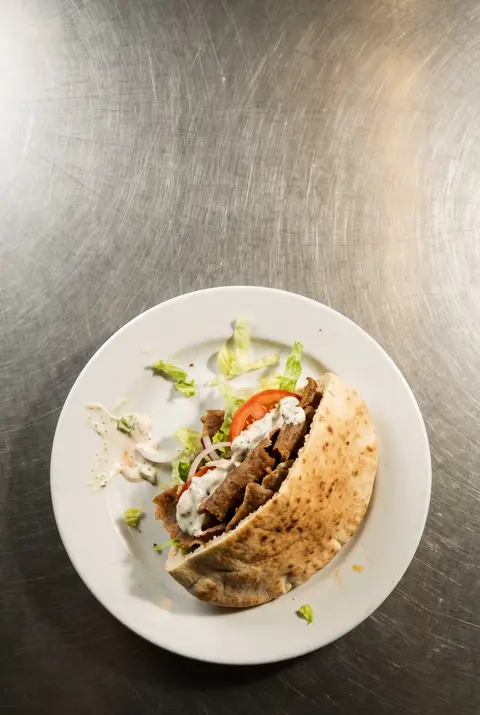
A name that means turning
Doner comes from the Turkish word donmek, to turn, and that is the whole idea: meat stacked on a spit that slowly turns in front of the heat. Roasting meat on a spit is ancient, and in Turkey it was long a dish for cooking outdoors. Miniature paintings by an Istanbul artist from around 1616 to 1620 show spit roasting. The food historian Mary Isin points out that the words doner kebab only show up in writing in 1908.
The spit stands up
The turning point came in the 1800s, when cooks switched from a horizontal spit to a vertical one. The meat cooks as it turns, and thin pieces are sliced off the outside. Two men are credited. Hamdi Usta of Kastamonu is one. Iskender Efendi of Bursa is the other, and his family says he came up with it as a boy at his father's restaurant. A photograph taken by James Robertson in the 1850s may show one of the first doners on record.
Bursa keeps its name on it
Iskender's claim lives on in a dish. Iskender kebab, from Bursa, is doner meat laid over pieces of pide bread with tomato sauce and melted sheep's milk butter. It is a plated dish. That is a long way from the doner most people in Europe know, which is held in one hand and eaten walking down the street. That version needed a move to another country.
Berlin, 1972
Between 1960 and 1973 nearly a million Turkish guest workers came to West Germany. One of them, Kadir Nurman, moved from Stuttgart to Berlin in 1966. In 1972 he opened a stand near Zoo station and sold doner meat with onion and some lettuce in flatbread, an easy lunch for busy workers. He is widely credited with the sandwich, but not by everyone. Nevzat Salim said he sold one in Reutlingen in 1969, and Mehmet Aygun says he made it in Berlin in 1971. Nurman himself said someone else may have done it first, but nobody noticed.
A German classic
The doner in bread grew into a big sandwich with lots of salad and sauces, sold cheap and in large portions. A Berlin museum exhibition in 2009 counted around 1,600 doner sellers in the city alone, and National Geographic puts the number of kebab shops at about 40,000 in Germany and 20,000 in the UK. Nurman got a lifetime award from the Turkish doner makers association in 2011 and died in Berlin in 2013. A typical doner is one filled flatbread, eaten as a full meal.