Who invented the pretzel?
Nobody knows who twisted the first one. Pictures of pretzels go back to the 11th and 12th centuries, and by then the knot was already the sign of bakers in southern Germany.
PretzelSoft pretzel250kcal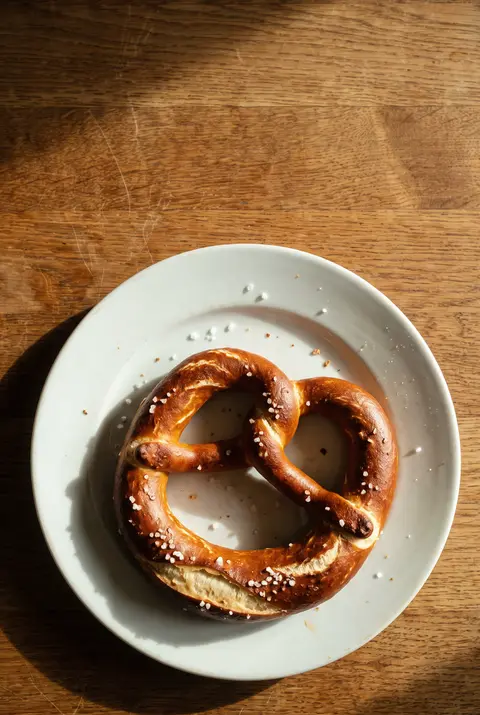
The monk and the praying arms
The best known story says an Italian monk made the first pretzel around the year 610. He crossed strips of leftover dough to look like arms folded in prayer and handed them to children as pretiola, little rewards. Another version puts it in a monastery in southern France. These are stories, with no record behind them. The name may really point to arms, though: German sources trace it to the Latin brachium, arm, and Smithsonian mentions brachiatus, with arms.
The oldest pictures
The hard evidence is in old books. The German encyclopedia entry lists two lectionaries from the monastery of Sankt Peter in Salzburg, dated around 1050 and between 1070 and 1090, now kept at the Morgan Library in New York. The Hortus deliciarum, a manuscript made in Alsace, shows pretzels at the banquet of Queen Esther and King Ahasuerus. Sources give different years for it, around 1160 or 1185, but all agree it is 12th century.
A sign over the bakery
The pretzel has been the emblem of bakers and their guilds in southern Germany since at least the 12th century. One baker's sign with a pretzel, dated 1111 at Speyer Cathedral, is known only from a drawing made in 1756. The knot also had a place in the church year. Made from just flour and water, it could be eaten in Lent, when eggs, lard and dairy were off the table. Bruegel even painted pretzels in his 1559 picture of Carnival fighting Lent.
The lye mix up in Munich
A shiny brown Laugenbrezel gets its crust from a quick dip in lye. Smithsonian notes it is lye that gives the German pretzel its gloss and flavour. The popular story says that in 1839 a Munich baker, Anton Nepomuk Pfannenbrenner, grabbed the lye instead of sugar water by mistake. The German encyclopedia calls this a legend: his supposed employer cannot be verified, and the company named was only founded in 1873. Swabian pretzels have a thick belly and thin arms; Bavarian ones are more even.
Across the ocean and to Oktoberfest
German speaking settlers from the south, the Pennsylvania Dutch, brought pretzels to America in the late 18th century. In 1861 Julius Sturgis opened a bakery in Lititz, Pennsylvania, the first commercial bakery for hard pretzels there. Back in Munich, the bread women at Oktoberfest still sell pretzels as big as a briefcase next to the beer. At a German bakery today, one large Laugenbrezel with butter is a normal snack, and it looks much like the knot over the old bakers' doors.