Who invented ketchup?
Nobody invented ketchup in one go. The word likely comes from a Chinese fish brine, English cooks made it from mushrooms and walnuts, and Americans turned it into the sweet tomato sauce Heinz sold from 1876.
Ketchup1 tablespoon of ketchup, 15 ml17kcal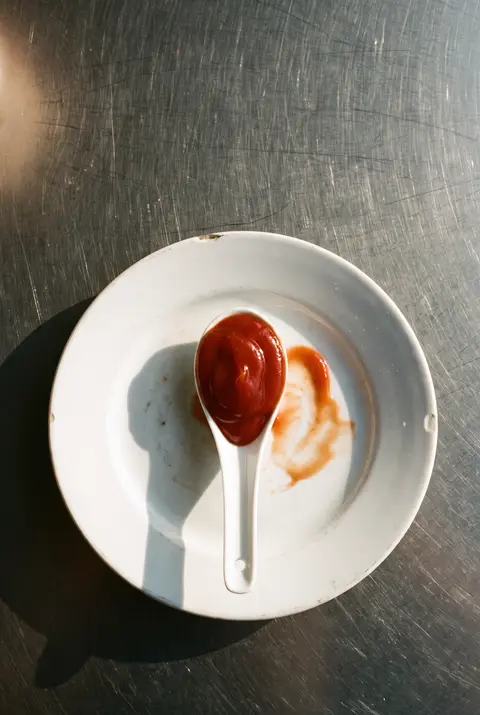
It started as fish
The ketchup in your fridge has a fishy past. Britannica says the word likely comes from the Chinese ke-tsiap, a brine made from pickled fish, probably by way of the Malay word ketjap. Smithsonian Magazine also traces the word back to a pickled fish sauce. So the name came first, and it travelled a long way before it ever met a tomato. That part is a best guess from word history, not a signed recipe, which is why the sources say likely and probably.
Mushrooms, walnuts and oysters
In Britain, ketchup was not red at all. Britannica describes it as a puree of mushrooms, unripe walnuts or oysters, used to season cooking rather than poured on a plate. English cooks pickled all sorts of things into catsups, as Smithsonian puts it. The habit lasted a long time. As late as 1901, the American forager Charles McIlvaine still suggested making ketchup from mushrooms, with a quart of red wine for every gallon of liquid, or brandy instead.
Enter the love apple
One of the first American tomato ketchup recipes was printed in 1812. Its author was James Mease, a doctor in Philadelphia, and it appeared in his Archives of Useful Knowledge. Tomatoes were called love apples then, so he called it Love-Apple Catsup. He told readers to add half a gill of brandy to each bottle, cork it tight and keep it somewhere cool. In 1876 the Heinz company began selling its own tomato version, and it called it catsup.
The fight over preservatives
Early bottled ketchup often spoiled, so makers added chemicals. National Geographic reports that Heinz used salicylic acid and then sodium benzoate. In 1902 the government chemist Harvey Wiley began testing preservatives on volunteers, a group nicknamed the Poison Squad. Heinz backed him. The Pure Food and Drug Act became law in June 1906. Sebastian Mueller, a cousin of Henry Heinz, worked out a recipe with no preservative: far more tomato pulp, balanced with vinegar, making the sauce thicker than the thin ketchups before it.
The bottle you can see through
Heinz sold its ketchup in clear glass, so you could check what you were buying, while rivals used coloured bottles. Smithsonian notes that the new rules pushed makers toward a shelf stable mix of salt, sugar, vinegar and ripe tomatoes. Britannica sums up American ketchup as a sweet puree of tomatoes, onions and green peppers with vinegar and pickling spice. Today a portion is usually a squeeze beside your fries, which is a long way from a jar of pickled fish.